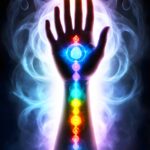
Beginning: Foundational Premise Vibration as Ontological Substrate:
The foundational premise underlying Mantra Science is that the observable material universe is fundamentally constituted by dynamic fields of energy operating through structured patterns of vibration.
Contemporary physics, particularly quantum field theory, recognizes that matter is not solid in the classical sense but rather an organized manifestation of interacting energy fields, oscillatory modes, and wave dynamics. At both quantum and macroscopic scales, form emerges from patterned vibratory phenomena.
In quantum formalism, particles are excitations of underlying fields. Stable structure arises when oscillatory systems achieve coherent states. Thus, vibration is not metaphorical, it is mathematically foundational.
Sounds as Structured Vibrational Input:
Sound is a measurable mechanical wave characterized by frequency (Hz), amplitude, waveform, and phase. Every articulated phoneme generates acoustic oscillations that propagate through air and biological tissues.
When structured rhythmically and phonetically as in mantra recitation sound becomes organized vibrational information. Such repetition has measurable physiological correlations to modulation of autonomic nervous system balance, Increased vagal tone, Brainwave entrainment (alpha and theta dominance), Reduced stress biomarkers.
Modern neuroacoustics suggests that repetitive acoustic patterns can synchronize neural oscillations, a phenomenon describable through phase-entrainment models in nonlinear dynamics.
Thus, mantra may be understood as structured acoustic input capable of influencing systemic coherence.
From Vibration to Cognition:
In the broader sense, the “word” may be understood as structured vibrational information, in which linguistic sound patterns carry organized energetic signatures capable of shaping perception, cognition, and affective states.
From a biophysical perspective, ordered oscillation corresponds to coherence, which in turn sustains stable structure; similarly, within living systems, rhythmic input promotes neural synchronization, leading to psychophysiological balance.
The Vedic Paradigm:
Within the Vedic framework, this vibrational ontology was articulated through the concepts of Nada meaning primordial sound, Shabda meaning structured sound and Spanda meaning dynamic vibration.
For example, the sacred invocation,
||Asato Ma Sat Gamaya Tamaso Ma Jyotir Gamaya |
Mrtyor Ma Amritam Gamaya Om Shanti Shanti Shanti ||
(From the Bṛhadaraṇyaka Upanishad 1.3.28) meaning Lead me from the Unreal to the Real, lead me from Darkness to the Light, lead me from Death to Immortality, Aum Peace, Peace, Peace
This mantra encapsulates the transformative arc of consciousness from ignorance to knowledge, fragmentation to unity, mortality-bound awareness to transcendental realization.
Transformational Proposition:
Mantra transforms the individual at multiple levels neurological, psychological, ethical, and spiritual.
It facilitates progression, From animal-man (instinct-driven existence). To man-man (self-aware, ethical human consciousness). To Godman (expanded awareness aligned with universal intelligence)
In modern language, this progression corresponds to reduction of limbic reactivity, increased cortical regulation, heightened empathic capacity, and strengthened prosocial neurocircuitry.
If practiced collectively, daily mantra meditation could reduce aggression, enhance emotional regulation, and promote cooperative behavior. Large scale psychological transformation can reduce the root causes of warfare, greed, and fragmentation of identity; from a systems perspective, this process unfolds as individual coherence giving rise to collective coherence, which in turn leads to reduced systemic conflict.
Liberation and Immortality, Scientific Interpretation:
The claim that mantra leads to liberation (moksha) and “immortality” may be understood on two complementary levels. Spiritually, liberation from the cycle of birth and death signifies transcendence of ego-bound identification and the realization of universal consciousness.
From a neurocognitive perspective, repeated contemplative practice reduces maladaptive identity fixation and reshapes neural pathways through neuroplasticity, fostering stable awareness that is less governed by transient emotional fluctuations.
In this context, “immortality” does not imply biological perpetuity but rather the transcendence of fear-based cognition, the dissolution of existential anxiety, and integration into a larger field of meaning; thus, mantra is described as conferring immortality because it shifts identification from transient form to enduring consciousness.
Mantra and the Ethical Orientation of Artificial Intelligence:
In an era increasingly shaped by artificial intelligence, the vibrational and ethical principles underlying mantra practice may offer an indirect but meaningful influence on technological development. AI systems reflect the cognitive, emotional, and ethical states of their creators and users; they are trained upon human-generated data and guided by human-defined objectives.
If individuals and institutions cultivate greater psychological coherence, emotional regulation, and compassion through disciplined practices such as mantra meditation, the values embedded in technological systems are more likely to reflect sattva meaning clarity, balance, and benevolence rather than aggression or fragmentation.
In this sense, mantra does not alter machine code directly, but it refines the consciousness that designs, governs, and deploys intelligent systems. A more coherent humanity produces more ethical intelligence.
In the End, Integrative Conclusion:
Mantra Science may be interpreted as an early systematic application of acoustic resonance and consciousness modulation.
While ancient seers expressed these principles through metaphysical language, modern science offers complementary mathematical and physiological frameworks that help illuminate their underlying mechanisms. The continuity between these perspectives lies in vibration quantum fields oscillate, biological systems oscillate, neural networks oscillate, and consciousness itself exhibits rhythmic patterns. Structured sound, applied with intention and sustained repetition, can therefore promote coherence within these interconnected oscillatory systems.
If humanity were to engage daily in disciplined mantra meditation, it is psychologically and sociologically plausible that aggression would diminish, empathy would increase, and collective behavior would move toward greater harmony.
Mantra, in this view, is not merely sound but disciplined vibrational alignment a bridge from chaos to coherence, from fragmentation to unity, and from mortality-bound fear to conscious integration. In that deeper sense, mantra represents a movement from the unreal to the real, from darkness to light, and from death to immortality. AUM SHANTI
Dr. Bharat Vaidya
Dr. Vaidya is a skilled Advanced Ayurvedic Physician who received his Ayurvedic degree (B.A.M.S.) and advanced medical training in Mumbai. He obtained a medical degree (M.D.) from the prestigious Catholic University of Leuven, Belgium, Europe. He has practiced medicine in India, Europe and in the U.S. He currently runs his practice in Superior, Colorado. Renowned Ayurvedic Physician, Dr. Vaidya, offers students an advanced and in-depth study of Ayurved. Ayurved Sadhana is approved by the Department of Higher Education as a Professional Occupation School inthe State of Colorado.