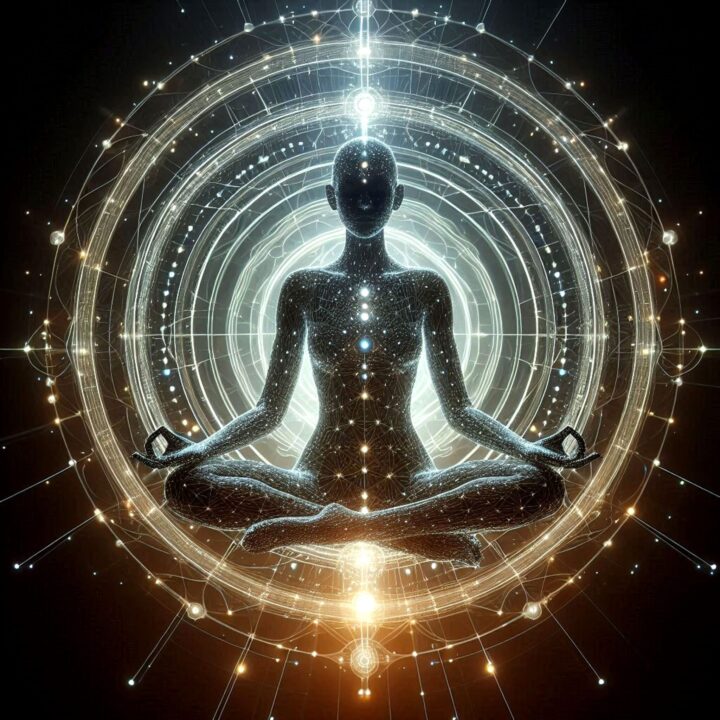
Have you ever noticed moments in life when everything seems to align perfectly? You think of someone, and they call. You dream of a place, and the next day you find yourself there. Carl Jung called these meaningful coincidences synchronicities, moments where the inner world of our mind and the outer world of events appear to speak the same language.
But what if there is more than just chance at play? What if the universe itself is subtly conspiring with our consciousness?
Modern physics, particularly quantum mechanics, provides a fascinating perspective. At the quantum level, particles do not behave like fixed objects—they exist in probabilities, in a haze of potentiality. It is only when observed that a particle “collapses” into a definite state. Some scientists suggest that consciousness may not merely witness reality—it may participate in shaping it.
Nobel laureate Wolfgang Pauli, who corresponded extensively with Jung, suggested that the observer and the observed are deeply connected, hinting that consciousness itself may participate in shaping reality. Physicist Fritjof Capra, in The Tao of Physics, draws parallels between Eastern mysticism and quantum mechanics, showing that the universe behaves more like a living organism
Synchronicity, then, can be seen as the bridge between the infinite possibilities of the quantum world and the reality we experience. When we align our intentions, thoughts, and awareness, we may be tuning into patterns that are already woven into the fabric of the universe.
Think of life as a cosmic dance. The more we move with awareness, the more the universe mirrors our rhythm. Quantum entanglement, where particles remain connected regardless of distance, hints at a deeper connection—our thoughts and intentions may ripple through unseen networks of reality, manifesting opportunities, signs, and serendipitous encounters.
This does not mean that we control everything, nor that every coincidence is meaningful. Synchronicity is subtle, often gentle, like a whisper of the universe. It asks us to pause, to notice, and to reflect on the invisible threads connecting us to the world and to each other.
Everyday Signs of Synchronicity
Synchronicity can show up in both subtle and striking ways. Some common examples include:
- Repeated numbers: Seeing 11:11 on the clock, license plates, receipts, or phone numbers can be more than coincidence—it can be a signal or pattern your consciousness is noticing.
- Animal symbols: Birds, butterflies, or other animals appearing at meaningful moments can carry messages. A crow crossing your path, a hummingbird showing up repeatedly, or a flock of birds in a certain formation may act as guidance or reflection of your inner state.
- Obstacles and repeated difficulties: Encountering the same challenges or annoyances when trying to connect with someone, accomplish a task, or make a decision can point to lessons, timing, or paths you are meant to reconsider.
- Unexpected encounters or messages: Thinking of someone and hearing from them immediately, or finding the exact resource you need at just the right moment.
- Dreams manifesting in reality: Dreaming of a place, event, or person and encountering it shortly after in waking life.
These events often feel magical because they occur just when we need them and create a sense of alignment or guidance from something larger than ourselves.
Five Ways to Notice and Invite Synchronicity
1. Pay Attention to Patterns and Signs
Jung observed that synchronicities often occur when we are focused on a question, problem, or inner intention. Keep a journal of unusual coincidences or repeating patterns. By noticing what you “tune into,” you start to see the subtle threads connecting events in your life.
2. Set Clear Intentions
Deepak Chopra writes in The Seven Spiritual Laws of Success: “What you pay attention to grows. What you ignore withers.” By clarifying your goals or intentions—even quietly in your mind—you begin to align your consciousness with the possibilities around you.
3. Cultivate Mindfulness
Quantum physics reminds us that observation affects outcomes. Mindfulness, meditation, or simply being fully present in your day-to-day activities increases your awareness of small cues and coincidences. Even noticing a subtle feeling or thought can make you receptive to meaningful signs.
4. Trust Your Intuition
Many synchronicities appear as nudges, hunches, or subtle impulses. Jung described the unconscious as a rich source of guidance. When you feel an inexplicable pull toward a person, place, or action, pause and consider the possibility that this is more than chance—it may be a moment of connection with deeper patterns.
5. Reflect on the Meaning
Not every coincidence carries significance, but when something stands out—especially if it resonates emotionally or spiritually—take time to reflect. Ask yourself: What might this be showing me? How does it connect to what I am currently seeking or experiencing?
By combining intention, mindfulness, and reflection, we can become more attuned to the subtle dance between consciousness and the world. Science calls it probability and entanglement; mystics call it magic. Synchronicity reminds us that the universe is far more connected than we often realize—and that by paying attention, we can participate in its unfolding.
Laura Lee
Spiritual teacher, healer, and writer
References for Further Exploration:
- Carl Jung, Synchronicity: An Acausal Connecting Principle
- Wolfgang Pauli & Carl Jung, The Interpretation of Nature and the Psyche
- Deepak Chopra, The Seven Spiritual Laws of Success
- Fritjof Capra, The Tao of Physics
- Rupert Sheldrake, The Science Delusion